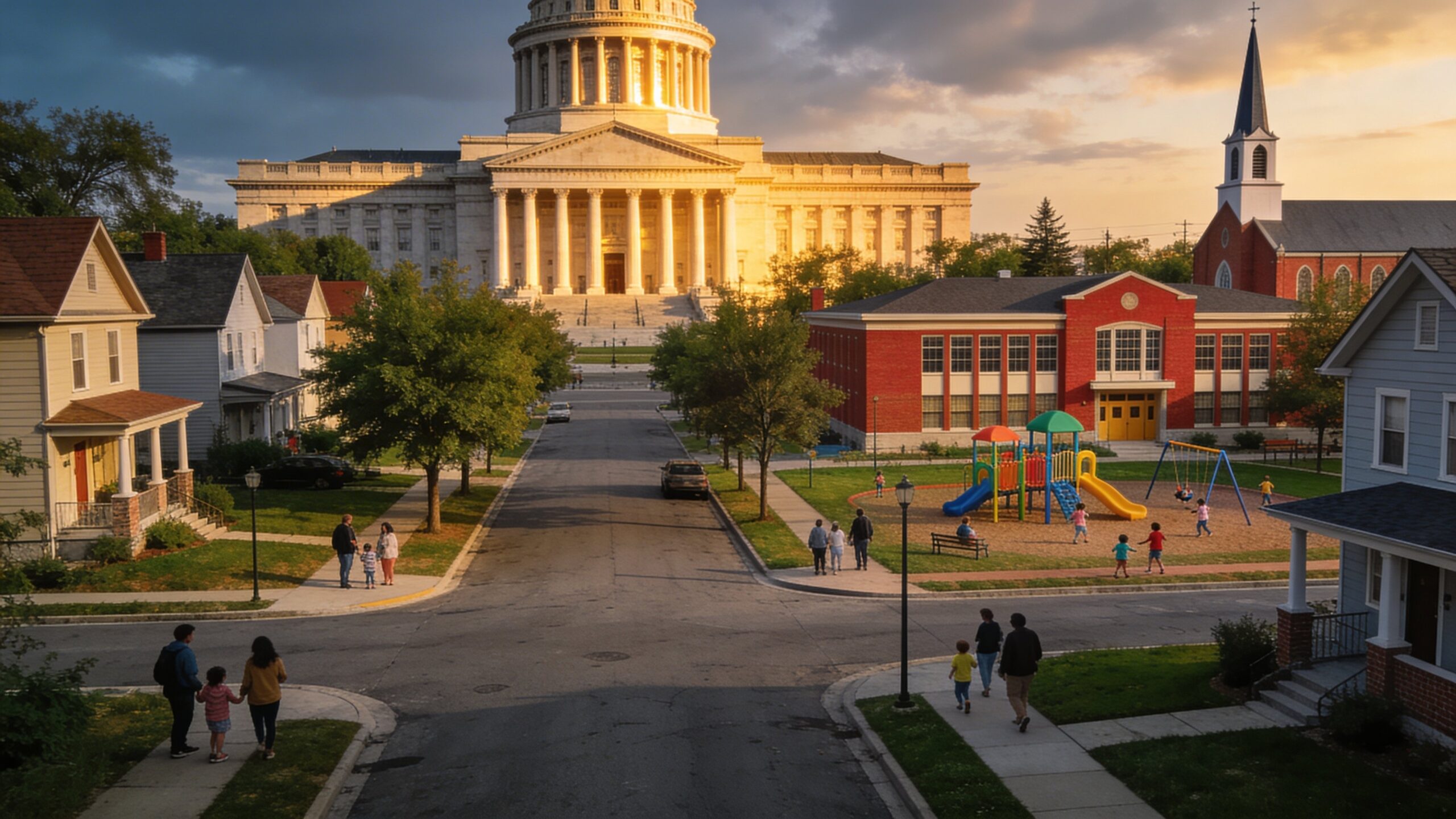
Conservative philosophy often begins with a simple but far-reaching conviction: society is not built from politics upward, but from relationships outward. In that view, the family is not merely a private arrangement or a lifestyle preference. It is the first school of duty, the first place where authority is encountered, the first setting where love becomes responsibility, and the first institution through which culture is carried from one generation to the next. Conservative thinkers have long treated family as one of the central building blocks of a stable social order, alongside faith, community, law, and tradition. This emphasis appears across many strands of conservative thought, including writers associated with tradition, moral order, continuity, and the importance of “little platoons” or intermediate institutions between the isolated individual and the central state.
A: Because conservatives often see it as the first source of moral formation, social stability, and cultural continuity.
A: Indirectly yes; they usually see it as pre-political but deeply influential on public life.
A: Tradition matters, but so do duty, love, sacrifice, and the raising of children.
A: They often argue that free societies need responsible citizens, and families help form them.
A: Marriage is usually seen as a stabilizing structure that supports long-term commitment and childrearing.
A: Conservatives often view family as a buffer that prevents too much dependence on centralized institutions.
A: No; they usually recognize family flaws but still see the institution as irreplaceable.
A: It carries memory, wisdom, and continuity from one generation to the next.
A: Often yes; many conservatives connect family life with faith, moral teaching, and spiritual inheritance.
A: Conservative philosophy sees family as the place where civilization becomes personal and lasting.
Why Family Matters Before Politics
In conservative philosophy, the family matters because it shapes the human person before ideology ever enters the picture. Long before someone votes, debates, or participates in public life, that person has already learned habits that make public life possible. Patience, sacrifice, loyalty, self-restraint, gratitude, and care for others are rarely taught first by government agencies or political campaigns. They are usually absorbed at home, often imperfectly but powerfully, through ordinary life. This is one reason conservatives tend to distrust visions of politics that promise to redesign society from the top down. They often argue that public life depends on moral and cultural capital that politics itself cannot create. Laws may punish wrongdoing, but they cannot manufacture affection. Bureaucracies may distribute resources, but they cannot fully replace trust, belonging, and inherited responsibility. For conservatives, the family stands at the center of this reality because it forms character in ways that abstract systems cannot.
The Family as the First Community
Conservatives often describe the family as the first and most natural community. It is where the individual first discovers that life is not centered entirely on personal desire. A child enters a world that already exists, with names, customs, obligations, expectations, and stories. This matters deeply in conservative thought because it reminds people that they do not invent themselves from nothing. They inherit a place in a larger chain of continuity.
That continuity is not just biological. It is moral, cultural, and civilizational. Families pass along language, manners, holidays, memory, and faith. They preserve a sense of where people come from and what they owe to others. In a conservative framework, this transmission is not oppressive by definition. It is one of the essential ways human beings are formed into responsible adults rather than left as disconnected consumers chasing appetite and novelty. The family introduces a person to the reality that freedom has to be guided by order, and choice has to be shaped by meaning.
Family and the Moral Order
A major theme in conservative philosophy is the belief that freedom without moral structure eventually becomes unstable. Conservatives often argue that a healthy society requires more than rights. It also requires duties, limits, and a recognition that not every desire should rule. The family becomes central here because it is one of the first places where moral order is made visible in everyday life.
In a family, people do not simply negotiate every responsibility as if they were strangers signing contracts. Parents care for children before children can repay them. Children are expected to learn obedience before they fully understand why rules exist. Spouses are called to fidelity not because it is always easy, but because permanence creates trust and trust creates the conditions for flourishing. From a conservative perspective, these bonds teach something essential about human nature: that love is strongest when joined to obligation, and that commitment is often what gives freedom its shape. This is why conservatives frequently speak about family in language that sounds deeper than policy. To them, family is not just a demographic unit. It is part of the moral architecture of civilization.
The Family as a Buffer Against Isolation
Another conservative argument for the importance of family is that it protects human beings from isolation. Modern life often encourages people to think of themselves primarily as individuals floating free from inherited ties. That can feel liberating at first, but conservatives tend to see a danger in it. When old bonds weaken, people do not necessarily become more whole or more independent. They may instead become more lonely, more anxious, and more dependent on remote institutions for support, identity, and validation.
The family, in conservative thought, is one of the strongest answers to this danger. It offers belonging before performance. A person is known there in a fuller way than in most public settings. Family life can be difficult, frustrating, and demanding, but conservatives often insist that its imperfections do not erase its necessity. In fact, the very challenge of living with others across generations teaches patience, forgiveness, realism, and resilience. These are qualities that consumer culture rarely rewards, but societies badly need. Conservative writers have often connected the weakening of family and other mediating institutions with the growth of centralized power, arguing that when human-scale communities erode, the individual stands more exposed before the state.
Generational Continuity and Inheritance
Conservative philosophy places enormous importance on time. It does not see society as a project begun by the living generation alone. Instead, it sees every generation as a steward, receiving an inheritance and passing it on. The family is where that principle becomes personal. At its best, family connects the past, present, and future in a way no manifesto can. Grandparents embody memory. Parents embody responsibility in the present. Children embody continuity and hope. Conservatives are drawn to this structure because it resists the arrogance of believing that the present moment is all that matters. It encourages humility. It reminds people that they are part of a longer story.
This generational dimension also explains why conservative philosophy often treats the family as a cultural institution rather than just an economic one. Families do not merely share expenses or living space. They preserve ways of life. They shape how a civilization understands duty, authority, gratitude, sex, marriage, aging, and death. Once these meanings are weakened, conservatives argue, politics alone cannot easily restore them.
Marriage and Stability in Conservative Thought
Within conservative philosophy, marriage is usually seen as one of the central pillars of family life. Different conservative traditions emphasize different reasons for this, but many converge on the same point: stable marriage creates a durable structure for love, childrearing, interdependence, and social continuity. Conservatives tend to value the public character of marriage because they do not see intimate life as purely private. What happens in the home affects the wider culture. Stable unions shape the emotional and moral environment in which children are raised. They influence neighborhoods, schools, crime rates, civic trust, and long-term social cohesion. In that sense, marriage is not only a personal bond but also a civilizing institution. This does not mean conservative thinkers are blind to the pain and complexity that can exist in family life. Rather, they often argue that the fragility of human relationships is exactly why institutions of commitment matter. When emotions change or hardship arrives, vows, norms, and expectations can help carry people through seasons that pure feeling cannot sustain on its own.
Parenthood as Responsibility, Not Lifestyle Branding
Conservative philosophy also tends to view parenthood in terms of obligation and stewardship. In a culture that often celebrates endless self-expression, conservatives frequently present parenting as a calling that redirects the self outward. A parent cannot remain entirely organized around personal convenience. The child introduces a permanent claim on time, energy, patience, and sacrifice.
That is one reason family occupies such a high place in conservative thought. It teaches that maturity is not simply autonomy. It is responsibility. A grown person is not just someone who can choose freely, but someone who can be trusted to care for others, accept limits, and remain faithful to duties that do not disappear when they become inconvenient.
Conservatives often believe that societies thrive when large numbers of people internalize this ethic. They see family life as one of the main places where such internalization happens. It is where idealism is tested against reality, and where moral language becomes concrete through chores, caregiving, discipline, forgiveness, and provision.
The Role of Fathers, Mothers, and Distinct Responsibilities
Many conservatives also stress that family life is strengthened when parental roles are taken seriously. Different schools of conservative thought debate how strongly those roles should be differentiated, but a common theme remains: mothers and fathers are not interchangeable abstractions, and children usually benefit when adults embrace their responsibilities with seriousness and consistency.
At the heart of this view is not merely nostalgia. It is the belief that stable roles create clarity, and clarity helps build trust. Conservatives often worry that when every role becomes endlessly negotiable, family life can become more fragile and uncertain. They see value in norms that encourage dependable care, reliable presence, and a moral seriousness about what children need. Even where conservatives disagree about modern applications, they usually share the belief that family cannot flourish if parental duty is treated as optional or secondary. The health of a society depends, in part, on whether adults are willing to place the needs of children above the moods of the moment.
Family, Faith, and Cultural Transmission
For many conservatives, family is closely tied to religion, not only because faith traditions often shape beliefs about marriage and duty, but also because family is one of the main vehicles through which spiritual and moral conviction is transmitted. Home is frequently where prayer is learned, where sacred stories are told, where reverence first takes root, and where moral language gains emotional meaning.
Even secular conservatives often recognize this pattern at a cultural level. They may argue that families help preserve moral frameworks that keep societies coherent. Without those frameworks, politics can become increasingly aggressive, because every moral disagreement must then be settled through law, bureaucracy, or ideology rather than through shared culture. This is one reason conservative philosophy often gives great weight to custom. Customs may look small from the outside, but they carry memory and shape expectations. Family dinners, holiday traditions, rituals of respect, habits of service, and multigenerational storytelling all help form the kind of citizen a society eventually receives.
A Check on the Expanding State
One of the most distinct conservative arguments about family is political in an indirect way: strong families reduce the pressure for politics to do everything. When families, neighborhoods, congregations, and local communities remain healthy, many human needs are met close to home. Care, guidance, discipline, support, identity, and belonging are provided through real relationships rather than distant administration. Conservatives do not usually claim that family can solve every social problem. Rather, they argue that when family weakens, other institutions rush in to fill the vacuum, often imperfectly. As a result, the state grows not only in size but in emotional and moral significance. It begins to take on responsibilities that once belonged to households, churches, and communities.
This concern does not arise merely from a desire for smaller government in the abstract. It arises from a belief about human dignity. Conservatives often think people flourish best when they live inside real networks of obligation and affection, not when they are managed primarily through centralized systems. The family is therefore politically important not because it is partisan, but because it limits the need for impersonal power.
Family and Human Imperfection
Conservative philosophy is usually skeptical of utopian thinking, and that skepticism applies to family as well. Conservatives do not generally believe families are perfect. They know homes can be wounded places. They know parents fail, marriages crack, and generations misunderstand one another. Yet this realism often strengthens rather than weakens the conservative defense of family.
Because human beings are imperfect, conservatives argue, society needs durable institutions that can absorb weakness without collapsing. Family is one of those institutions. It can bend, forgive, repair, and endure in ways that more transactional arrangements cannot. Conservatives tend to prefer strengthening families over replacing them, not because families never fail, but because no substitute fully replicates their moral and relational depth. This realism also explains why conservative thought often emphasizes repair over reinvention. The goal is not to romanticize the family, but to renew it. The family remains worth defending because it answers permanent human needs: the need to belong, to be formed, to be loved, to be corrected, and to be remembered.
Why Conservatives See Family as Civilizational
At its deepest level, conservative philosophy sees family as civilizational because it joins love to continuity. It takes the most intimate human bonds and turns them into a structure through which society reproduces itself morally as well as biologically. Politics can protect some of that structure, but it cannot create it from scratch.
That is why conservatives so often return to family when discussing education, culture, liberty, economics, crime, religion, and national identity. They do not see family as one issue among many. They see it as the place where many issues begin. If the family is stable, loving, and morally serious, society has a stronger chance of remaining free and ordered. If the family becomes weak, fragmented, or culturally hollow, even the best-designed political system will struggle. In this sense, the conservative defense of family is not simply about preserving an old form. It is about protecting the human setting in which virtue, trust, sacrifice, and continuity can still be learned. That is why the family remains so central in conservative philosophy. It is not merely where people live. It is where civilization starts.
Conclusion
The role of family in conservative philosophy is far larger than a narrow policy preference or a sentimental appeal to tradition. It reflects a broad understanding of how people become capable of freedom, responsibility, and civic life. Conservatives view the family as the first community, the first moral classroom, the first defense against loneliness, the first bridge between generations, and one of the last protections against a society ruled only by appetite or administration. Whether one agrees with every conservative conclusion or not, the seriousness of this argument is clear. It begins with an insight about human nature: people do not thrive as isolated units. They need belonging, duty, memory, and love. Conservative philosophy believes the family is the institution most capable of teaching all four. That is why it remains at the heart of conservative thought.